Foods
Farmed Fish
Farmed fish are raised in crowded pens on industrial feed compounded from vegetable oils and contaminated fish meal, allowing PCBs, dioxins and PBDE flame retardants to bioaccumulate at concentrations significantly higher than in wild counterparts. The omega-3 to omega-6 ratio collapses from roughly 10 in wild salmon to only 3–4 in farmed, converting a supposedly anti-inflammatory meal into a pro-inflammatory one. Aquaculture also consumes vast quantities of antibiotics and sea-lice treatments such as emamectin benzoate.
Dr. Diaa's words
Dr. Diaa does not address farmed fish directly in the available episodes; rather, his rejection falls within his broader critique of the industrial food system: "current agricultural practices — feeding animals on unnatural feed and using hormones — produce contaminated food" (from his episode "The New Food Pyramid," January 2026).
When Science published Hites and colleagues' 2004 analysis of over two metric tonnes of farmed and wild salmon, the verdict was unambiguous: organochlorine concentrations were significantly higher in farmed fish, and European-raised salmon carried the heaviest toxic burden. Foran's 2005 risk assessment in Environmental Health Perspectives translated this into stark consumption advice — farmed Atlantic salmon from northern Europe should be eaten no more often than once every five months to stay below an acceptable cancer-risk threshold. Hamilton's parallel work in Environmental Science & Technology then exposed the lipid story: the omega-3 to omega-6 ratio collapses from roughly 10 in wild salmon to 3–4 in farmed.
The problem extends beyond salmon. Done and Halden detected five antibiotics across shrimp, tilapia, catfish and salmon sold in the United States — including virginiamycin residues in salmon marketed as "antibiotic-free." Bloodworth found the sea-lice drug emamectin benzoate in 97% of sediment samples around Scottish farms, while Bateman documented that Pacific sea lice have now evolved resistance to that same drug. Naylor showed in Nature that farming carnivorous species actually depletes wild stocks used as feed rather than relieving pressure on the oceans. Three failures therefore converge on a single plate: contaminants bioaccumulate in the flesh, a distorted fatty-acid profile cancels the supposed nutritional benefit, and antibiotic and pesticide use threatens both human and ecological health.
What the research shows
7 / 22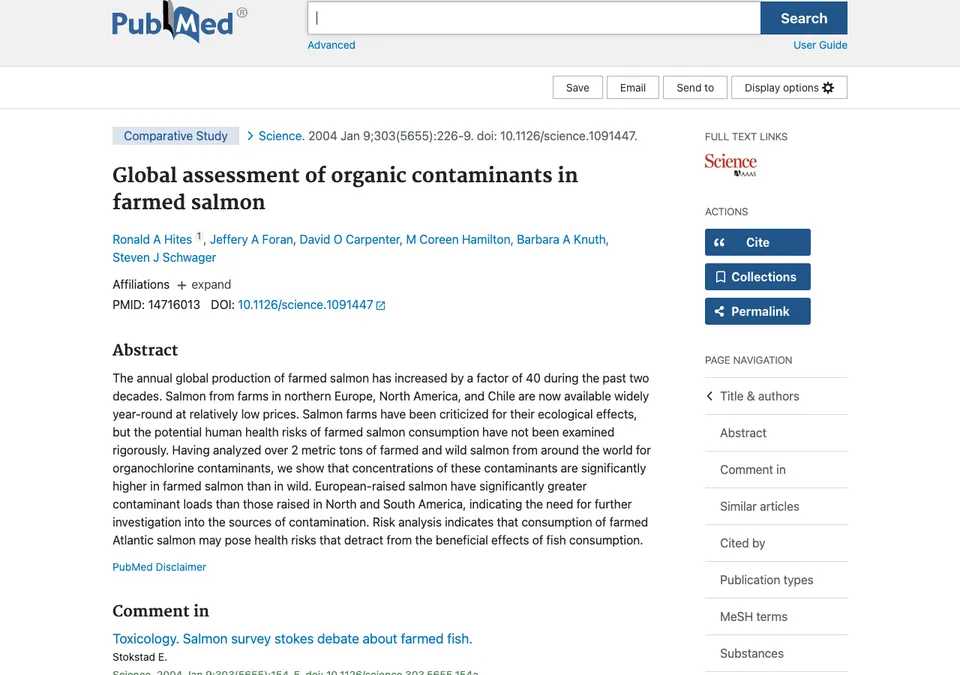
Farmed salmon carry significantly higher concentrations of PCBs, dioxins and chlorinated pesticides than wild salmon, with European farms the most contaminated.
Concentrations of organochlorine contaminants are significantly higher in farmed salmon than in wild. European-raised salmon have significantly greater contaminant loads than those raised in North and South America.
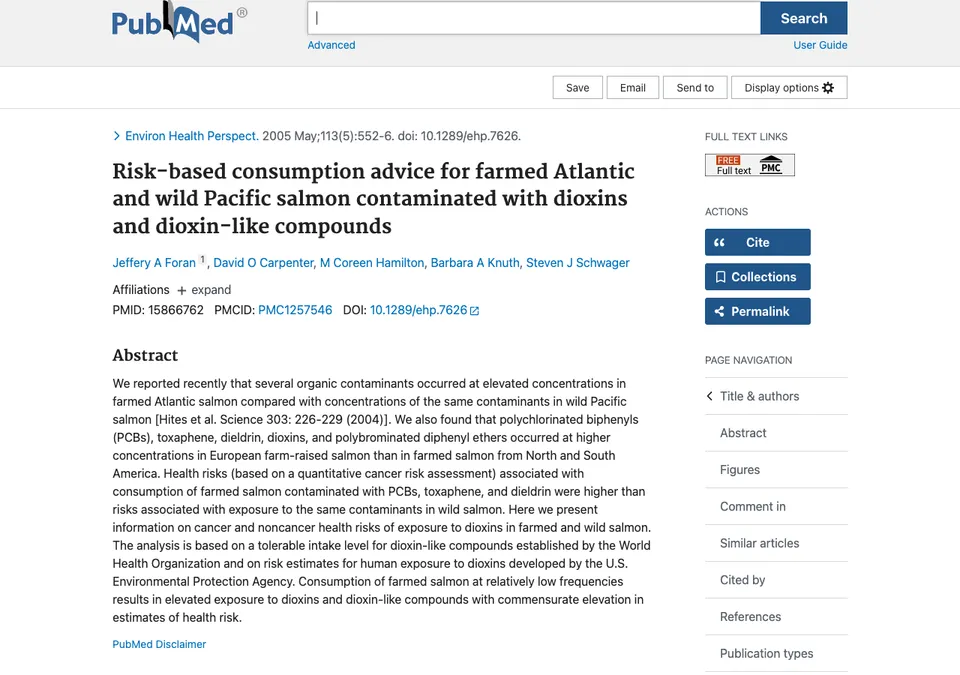
Dioxin-contaminated farmed salmon should be eaten less than once per month to remain below tolerable health-risk thresholds.
Consumption of farmed salmon at relatively low frequencies results in elevated exposure to dioxins and dioxin-like compounds with commensurate elevation in estimates of health risk.
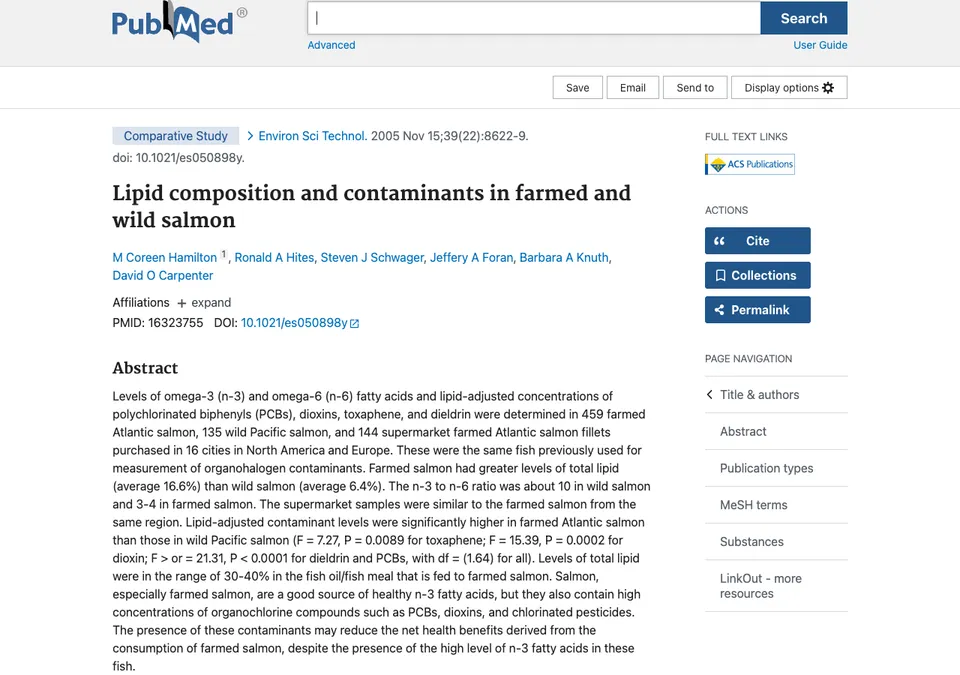
Farmed salmon contain over twice the fat of wild salmon but the omega-3:omega-6 ratio collapses from roughly 10 to only 3–4.
Farmed salmon had greater total lipid (16.6%) than wild salmon (6.4%). The n-3 to n-6 ratio was about 10 in wild salmon and 3–4 in farmed salmon.
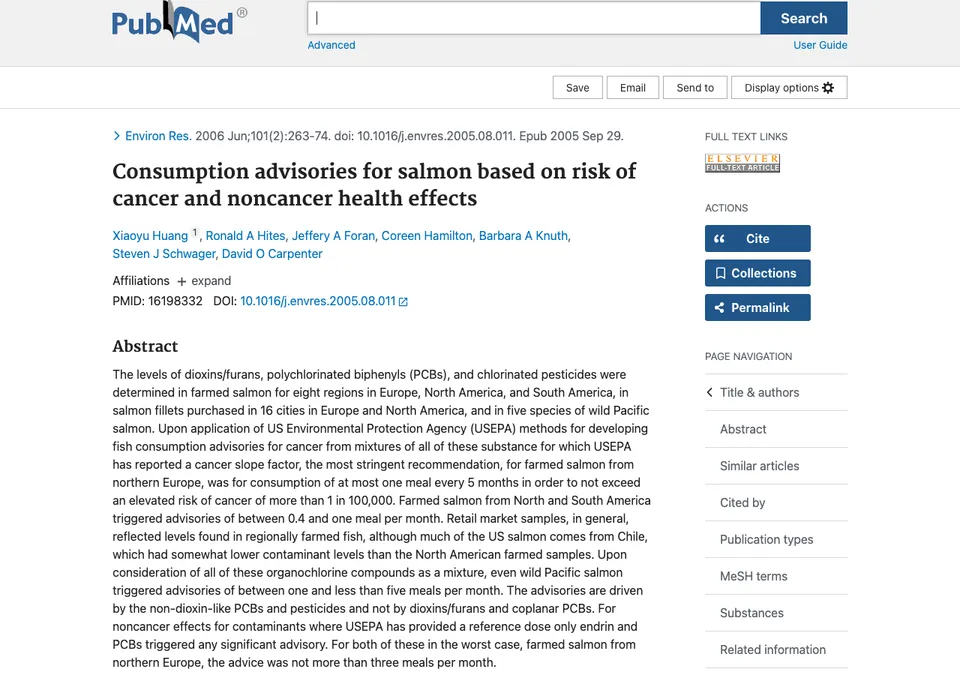
EPA-based consumption advisories recommend at most one meal every five months of northern-European farmed salmon.
The most stringent recommendation, for farmed salmon from northern Europe, was for consumption of at most one meal every 5 months in order to not exceed an elevated risk of cancer of more than 1 in 100,000.
Tilapia and catfish, the most widely farmed fish, have low omega-3 and high omega-6 levels, producing a pro-inflammatory fatty-acid profile.
Tilapia and catfish have much lower concentrations of n-3 PUFA, very high ratios of long chain n-6 to long chain n-3 PUFAs, and fatty acid characteristics that are generally accepted to be inflammatory by the health care community.
Roughly 80% of antibiotics used in aquaculture escape into the environment, accelerating antimicrobial resistance transferable to human pathogens.
Approximately 80% of antimicrobials used in aquaculture enter the environment with their activity intact, selecting for bacteria whose resistance is transmissible to other bacteria.
Emamectin benzoate, a sea-lice treatment, was found in 97% of sediment samples around Scottish salmon farms and reduced benthic crustacean diversity.
Emamectin benzoate was found in 97% of samples, and modelling showed it had the strongest negative effect on total crustacean abundance and species richness.