Foods
The Danger of Carbonated Soft Drinks
Sodas — both sugary and diet — load the body with liquid calories that fail to satisfy, fructose that overwhelms the liver, phosphoric acid that drains bone, and artificial sweeteners that disturb gut bacteria. The cumulative evidence: weight gain, diabetes, heart disease, stroke, kidney disease, fatty liver, gout, decay, and a measurable rise in early death.
Dr. Diaa's words
Dr. Diaa warns sharply against soft drinks, calling them the worst drink of all — for the way they wreck digestion, trigger reflux, rot teeth, and disturb the stomach's own acidity.
Soda isn't a drink in any sense the body recognises. It is a concentrated dose of liquid sugar — or of artificial sweeteners the digestive tract has never met before — dissolved in water acidified with phosphoric or carbonic acid. It enters the stomach, disturbs its native acidity, and throws off everything downstream. Dr. Diaa puts it plainly: the worst drink there is. He ties it to reflux, indigestion, and tooth decay, and along with white flour he places it at the top of the prohibited list in the Tayyibat system.
The largest population studies confirm his bluntness with striking precision. A meta-analysis of 11 cohort studies in Diabetes Care (2010), covering more than 310,000 people, found that drinking one to two cans of a sugary beverage per day raised the risk of type 2 diabetes by 26% and metabolic syndrome by 20%. A newer meta-analysis in the BMJ (2015) put the figure at an 18% jump in diabetes risk for every single daily serving.
The heart pays the same bill. A 24-year follow-up of 88,000 nurses, published in the American Journal of Clinical Nutrition (2009), showed that two or more servings per day raised coronary heart disease risk in women by 35%. The most sobering: a Circulation paper from 2019 tracking more than 118,000 adults for 34 years reported that two-plus daily sugary drinks raised cardiovascular mortality by 31% and total mortality by 21%.
Fructose deserves its own paragraph. In a controlled trial in the Journal of Clinical Investigation (2009), overweight volunteers drinking fructose-sweetened beverages for ten weeks gained visceral fat around the organs, saw their LDL cholesterol climb, and lost insulin sensitivity. The matched group drinking the same calories as glucose suffered none of this. That is why Choi and Curhan, writing in the BMJ (2008), found that two daily sugary sodas double the risk of gout in men.
Anyone hoping that diet soda is the safe alternative should look at the most jarring number in the whole file. The Framingham analysis in Stroke (2017) found that one diet soda per day was associated with nearly triple the risk of ischemic stroke (HR 2.96) and roughly triple the risk of Alzheimer's dementia (HR 2.89). Part of the mechanism, as a landmark Nature paper showed in 2014, is that artificial sweeteners reshape the gut microbiome, inducing glucose intolerance in mice and in healthy human volunteers alike.
Even setting sweeteners aside, cola itself has a problem: phosphoric acid. In the Framingham Osteoporosis Study (2006), women who drank cola daily — sugary or diet — had femoral-neck bone density 3.7% lower than non-drinkers, after adjusting for age, calcium, and vitamin D. The Tayyibat rule, for anyone willing to abide by it, is simple: neither the sugary soda nor the diet one.
What the research shows
7 / 23
Meta-analysis of 11 cohort studies: one to two sugary sodas per day raised type 2 diabetes risk by 26% and metabolic syndrome risk by 20%.
Based on 11 studies including 310,819 participants and 15,043 cases of type 2 diabetes, individuals in the highest quantile of SSB intake (most often 1-2 servings/day) had a 26% greater risk of developing type 2 diabetes than those in the lowest quantile (RR 1.26, 95% CI 1.12-1.41).
Framingham follow-up of 4,000+ adults: one diet soda per day was associated with nearly triple the risk of ischemic stroke and triple the risk of Alzheimer's dementia.
When comparing daily cumulative intake to 0 per week (reference), the hazard ratios for artificially sweetened soft drinks were 2.96 (95% CI 1.26-6.97) for ischemic stroke and 2.89 (95% CI 1.18-7.07) for Alzheimer's disease.
34-year follow-up of 118,000+ US adults: two or more daily sugary drinks raised cardiovascular mortality by 31% and total mortality by 21%.
Among 118,363 participants, two or more daily sugar-sweetened beverages raised total mortality by 21%, cardiovascular mortality by 31%, and cancer mortality by 16%. Artificially sweetened beverages at the highest intake were linked to a 13% rise in CVD mortality.
Controlled trial: 10 weeks of fructose-sweetened beverages increased visceral fat, raised cholesterol, and reduced insulin sensitivity — while the same calories from glucose did not.
Fructose specifically increased visceral adipose volume, hepatic de novo lipogenesis, fasting apoB, LDL, small dense LDL, oxidized LDL, and decreased insulin sensitivity — none of which occurred with the same caloric load of glucose.
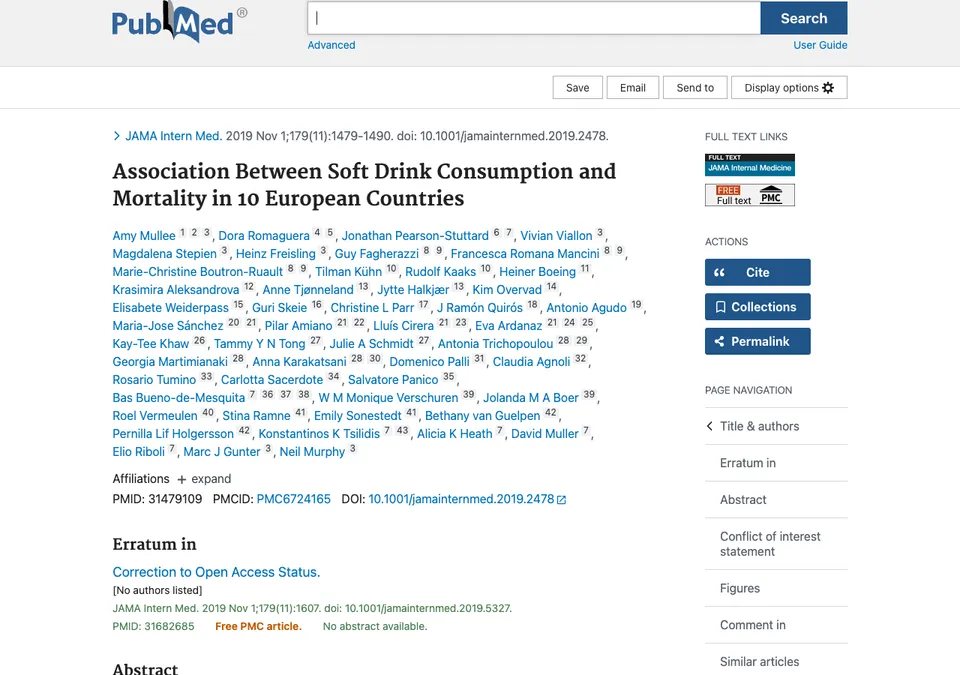
Largest European cohort, 451,000 people: two or more daily soft drinks raised all-cause mortality by 17%; diet drinks were specifically linked to circulatory mortality.
Among 451,743 participants across ten European countries, drinking two or more glasses per day was tied to higher all-cause mortality: HR 1.08 for sugar-sweetened and HR 1.26 for artificially sweetened. The latter were specifically associated with a 52% rise in circulatory-disease deaths.
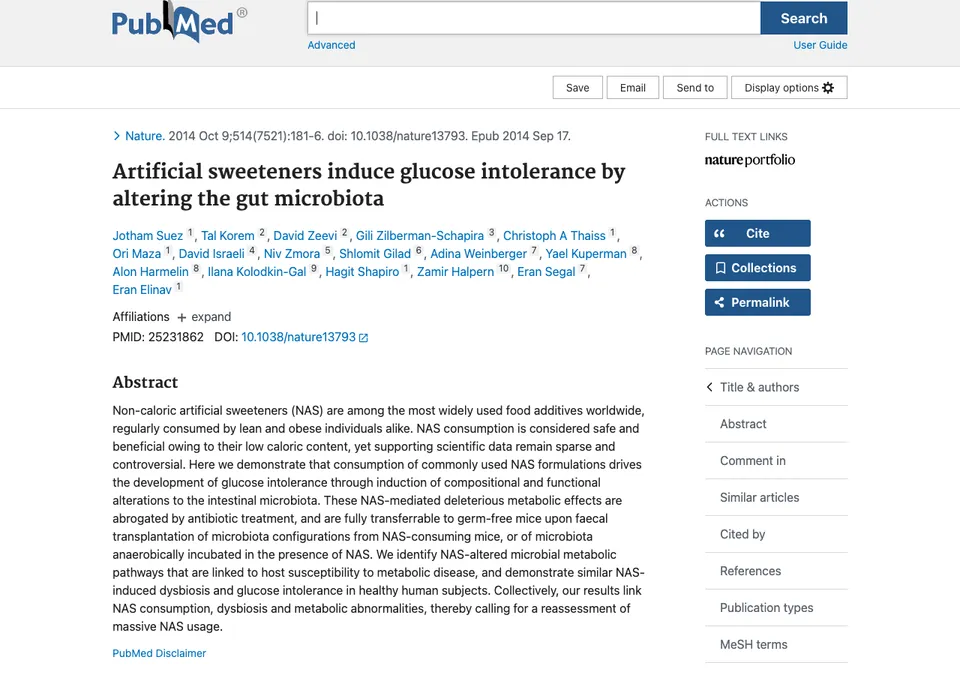
Artificial sweeteners (saccharin, sucralose, aspartame) alter the gut microbiome and induce glucose intolerance in mice and in healthy human volunteers.
Non-caloric artificial sweeteners drive the development of glucose intolerance by inducing compositional and functional alterations of the intestinal microbiota. The effect was abrogated by antibiotics, was fully transferable to germ-free mice via faecal transplant, and reproduced in healthy human volunteers.
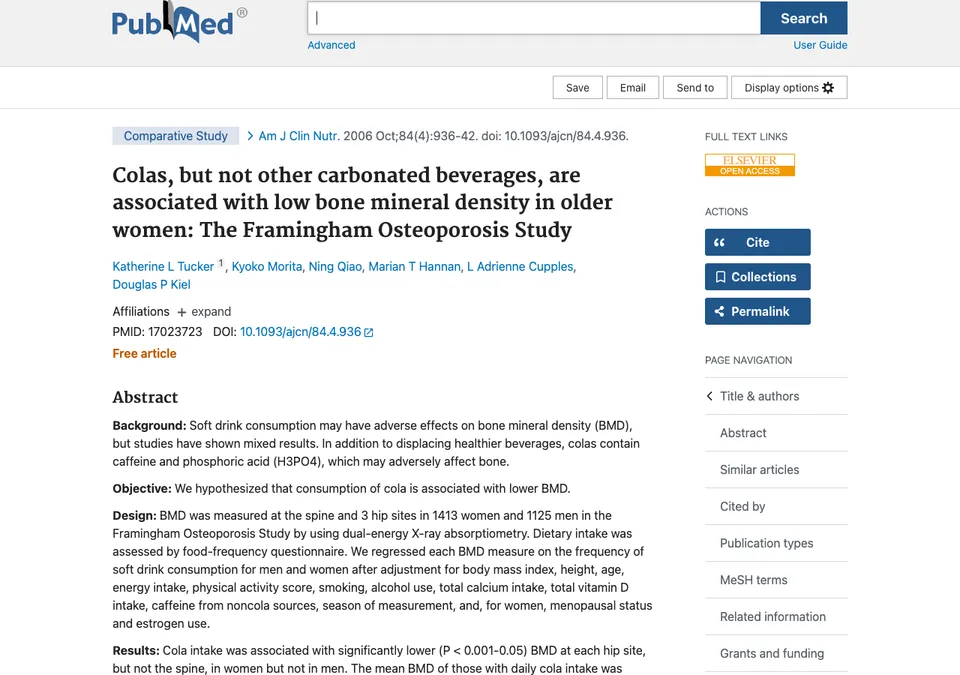
Women who drink cola daily — sugary or diet — have significantly lower hip bone mineral density, independent of age, calcium, or vitamin D intake.
The mean bone mineral density of women with daily cola intake was 3.7% lower at the femoral neck and 5.4% lower at Ward's area than women consuming less than one serving per month.